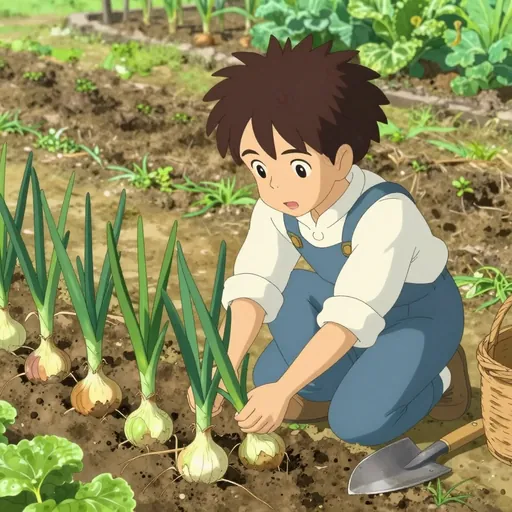
tree onion
Noun: A type of perennial onion (Allium × proliferum) grown primarily as a curiosity or for its early, edible greens and bulbils. It is characterized by producing clusters of small aerial bulbils (tiny bulbs) at the top of its flowering stalk, which often replace the flowers entirely.
The term "tree onion" is used to refer to the specific plant species. It functions as a countable noun. - It is often discussed in gardening, horticultural, or culinary contexts. - It is also known by other common names, such as Egyptian onion, top onion, or walking onion.
- The tree onion is interesting because it reproduces primarily through its aerial bulbils.
- I planted some tree onions in my garden to have an early supply of salad onions.
- Unlike most onions, a tree onion sets bulbils where you would expect to see flowers.
- As a modifier: The term can be used attributively to describe related things.
- She gave me some tree onion sets to plant.
- The recipe calls for tree onion greens.
- Egyptian onion: A common synonym for tree onion.
- Top onion: Another synonym, referring to the bulbils forming at the top of the stalk.
- Walking onion: A synonym that describes how the plant "walks" as the heavy top of the stalk bends to the ground, allowing the bulbils to root.
- Bulbil: A small aerial bulb, which is the defining reproductive feature of the tree onion.
- Egyptian onion
- Top onion
- Walking onion
The "tree onion" is distinct from the common onion (Allium cepa). Its primary defining characteristic is its method of reproduction via aerial bulbils. While it is edible, its classification as a "curiosity" in the definition highlights its unique growth habit, which is often of more interest to gardeners than its culinary yield compared to standard onion varieties.
-
type of perennial onion grown chiefly as a curiosity or for early salad onions; having bulbils that replace the flowers
Khám phá thêm
Các từ liên quan
Từ đồng nghĩa